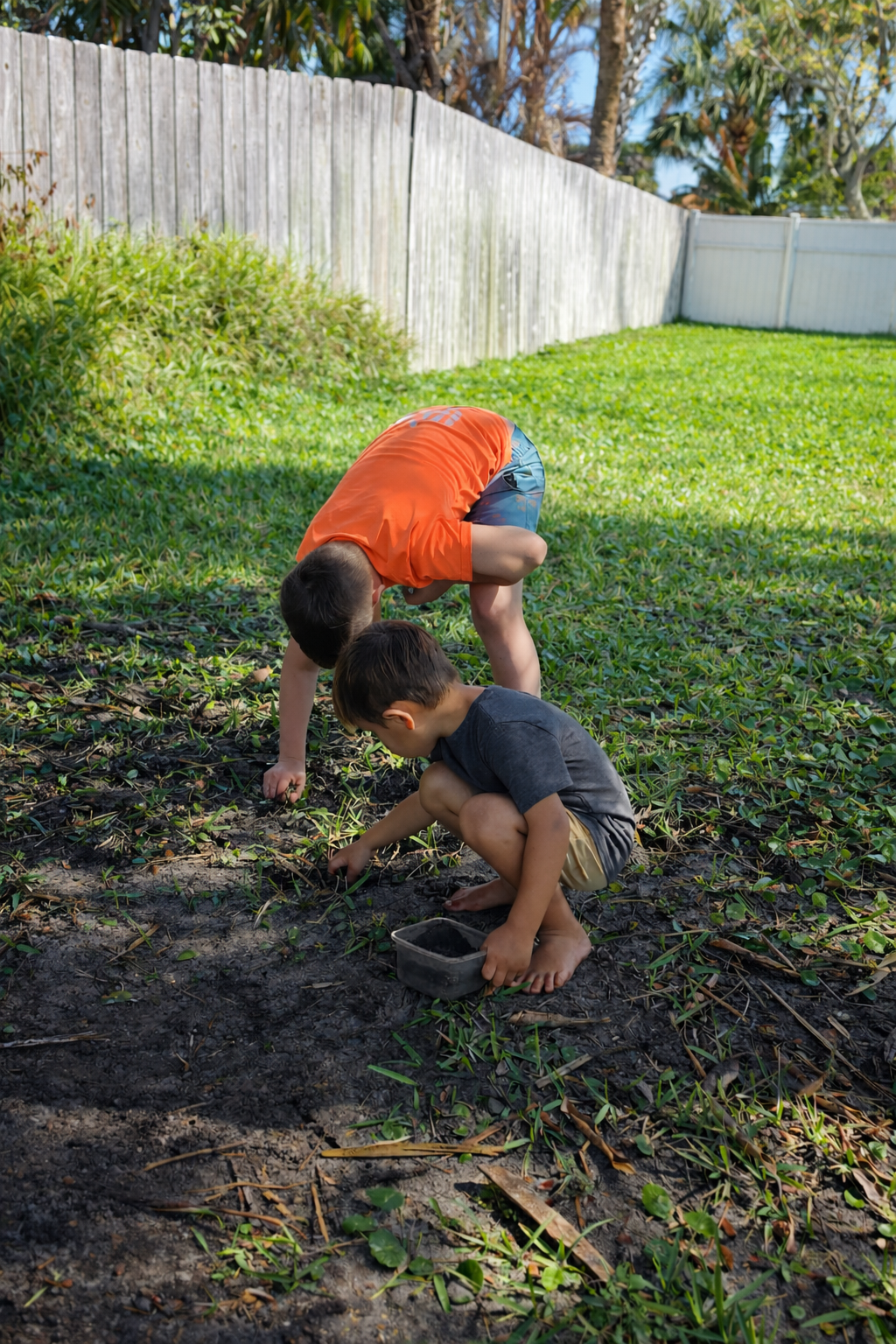
There’s a moment every parent recognizes — when your child is so completely absorbed in what they’re doing that the rest of the world disappears. No screens. No instructions. No timer counting down. Just hands in the earth, eyes wide, minds fully alive.
That’s what unstructured, self-directed play looks like. And it might be the most powerful form of learning there is.
Little Scientists at Work
When children dig in the dirt, they’re not just playing — they’re conducting experiments. What happens when I add water to this soil? Why is this layer darker than that one? What lives underneath this rock?
They don’t need a curriculum to ask these questions. They need space, time, and the freedom to follow their curiosity wherever it leads. A backyard, a garden bed, a patch of sand by the shoreline — these are laboratories disguised as playgrounds.
At Shoreline Scholars, we see this every session. Give children access to the natural world, step back just enough, and watch what happens. They form hypotheses. They test ideas. They observe, compare, and draw conclusions. They become natural scientists — not because someone told them to, but because that’s what humans do when they’re free to explore.
Shared Goals, No Script
Look closely at two children working together in the dirt and you’ll see something remarkable: collaboration without instruction. One digs. The other carries. They negotiate roles, share tools, solve problems, and adjust their plan — all without an adult directing the process.
This is what researchers call “collaborative free play,” and it builds skills that no worksheet can teach: communication, empathy, compromise, leadership, and the ability to work toward a shared goal. These are the social-emotional muscles that carry children through school, friendships, and eventually, adulthood.
Why It Matters
In a world that increasingly schedules every minute of childhood, unstructured outdoor play is becoming rare. But the research is clear — children who spend regular time in nature show improved attention, reduced anxiety, greater creativity, and stronger social bonds.
They also develop something harder to measure but equally important: a sense of belonging in the natural world. A child who has dug in the dirt, watched a seed sprout, and felt the earth between their fingers grows up understanding — in their body, not just their mind — that they are part of something larger than themselves.
Let Them Play
So the next time your child comes home with dirt under their fingernails, mud on their knees, and a rock collection in their pocket — don’t worry. That’s not mess. That’s education.
That’s a child who spent their afternoon being exactly what they’re supposed to be: curious, free, and fully alive.
At Shoreline Scholars, outdoor exploration isn’t a break from learning — it is the learning. Want to learn more about our nature-based programs? Visit our Program page or get in touch.